
Solemnity of the Most Holy Body and Blood
of the Lord, “Corpus Christi”
On the night before giving His life on the cross, Jesus instituted the Eucharist, the gift of His Body and Blood, in the form of bread and wine, as the perpetual Passover sacrifice for His followers. This was done in the context of what is traditionally called the Last Supper. The Solemnity we celebrate this Sunday, June 11, centers on the gift of the Body and Blood of the Lord, which we partake in at Holy Mass (the Eucharist) until the Lord comes again in glory at the end of the ages.
Instituting the Eucharist at the time when the Jewish Passover lambs were being sacrificed, Jesus inaugurated the Christian Passover. As the ancient rite commemorated the freedom of God’s people from slavery in Egypt, the Christian ritual recalls freedom from sin and death and the gift of new life being offered in and through Christ, who rose from the dead to bring eternal life.
The Protestant reformers of the sixteenth century, including Zwingli, Calvin, Luther, and others, taught that the Holy Eucharist was simply a symbol. The unbroken teaching of the Church is that we behold and receive in the Eucharist the Real Presence of the Risen Lord, who promised to be with us until the end of time. It is a great mystery yet at the same time a simple truth: God-is-with-us in a very special and singular way in the Blessed Sacrament, both received at Holy Communion and adored in the Tabernacle or exposed on the altar at Exposition and Benediction.
The Mass, Holy Eucharist, is the sacrifice or offering of the new covenant in the Blood of Christ. It is likewise the offering of the faithful, God’s people, united to Jesus in praise of the One God.
St. Paul the Apostle preached that the entire life of a Christian is a prolongation of the Eucharist, as a spiritual sacrifice offered to God in union with Christ. For this reason, St. Paul exhorted his hearers to offer themselves as a living sacrifice, holy and acceptable to God. This is the message for each of us today as well and the heart of our religion and worship, in spirit and truth.
The Mass never ends, we might say, because at the conclusion of every Mass, we are “sent forth” to announce the Good News of salvation in Jesus Christ, to the ends of the earth, by our words and especially by our deeds. As tabernacles of the Lord, by receiving His Body and Blood, we are commissioned with a special task that not everyone has embraced: to be “bearers of Christ” to all people until our final breath. Could there be a higher call?
2024 Mass Intentions
The 2024 Mass Intention Calendar will open on Tuesday, June 20. You may come to the parish office at 8:30 am with your Mass Intentions for the calendar year 2024. Each Mass Intention is $10. The Parish Office accepts checks or cash.
In his message about resuming the reception of Holy Communion under both forms, Archbishop Jerome Listecki promised to provide some solid, Eucharistic theology to help us all understand the transition. Below is part three of five articles:
The Eucharist as Sacrifice
How often do we use the word “sacrifice” to mean something we “offer up” or “do” for ourselves or someone else? The word “sacrifice” often has connotations of self-deprivation, inconvenience, or even suffering. Some examples of sacrifices are when parents lose sleep to care for a sick child or spouses mutually cooperate to build a life together. Everyone makes financial sacrifices to ensure a more secure life in the future. During Lent, we sacrifice food to share it with those who would otherwise go hungry. Sometimes someone sacrifices a kidney so their loved one can live. The word sacrifice conveys many meanings; however, at the root of each of these examples is love.
The Eucharist is a Real Sacrifice. During the Eucharistic Prayer, the priest says the words of Jesus at the Last Supper over the gifts of bread and wine: “This is my Body, which will be given up for you,” and “This is the chalice of my Blood … which will be poured out …” These words point forward to the death that Jesus would die for us on the Cross, making the Last Supper a sacrificial meal.
The sacrifice of the Mass is not a reenactment, imitation, or a dramatization of the Last Supper; rather, the Catechism of the Catholic Church says it “makes present the one sacrifice of Christ.” Scripture tells us that Jesus Christ “entered once for all into the sanctuary … with his own blood, thus obtaining eternal redemption.” (Hebrews 9:12) The historical sacrifice of Christ on the Cross is not repeated, but instead, the sacrifice of the Mass is a memorial in which Christ’s sacrifice is sacramentally present.
The Eucharist as the sacrifice has another dimension. After the gifts of bread and wine have been presented by the assembly and placed on the altar, the priest invites us to pray in these words: “Pray, brothers and sisters, that my sacrifice and yours may be acceptable to God, the almighty Father.” The privilege of participating in the Eucharist is that we take part in what we enact. God’s Love for us, manifested in the Sacrifice of Christ on the Cross, begs a response from us: love in response to love, sacrifice in response to sacrifice. When we participate in Mass, we offer God our thoughts, prayers, words, deeds, trust, service, and charity — our very lives and everything that we are — and we pray that we may be transformed and so be gathered into one in the unity of the Body of Christ. As St. Paul says in his letter to the Romans, “by the mercies of God, to present your bodies as a living sacrifice, holy and acceptable to God, which is your spiritual worship.” (12:1) Eucharistic Prayer IV explicitly asks that God’s people “may truly become a living sacrifice in Christ.”
The Eucharist is a Real Sacrifice — it is Christ’s once-for-all, loving sacrifice for us. It is also our sacrifice — the loving surrender of our wills and our lives to God. When we receive Holy Communion, we are strengthened by Christ’s Real Presence so that we can do the Father’s will. The Mass, which perpetuates the unbloody sacrifice of Christ, strengthens us to live the sacrifices which the Christian life demands. Next week, part four will be provided.

Friends, today’s Gospel passage is one of the most shocking in the New Testament. Those who heard it were not only repulsed intellectually; they were disgusted, viscerally. For a Jewish man to be insinuating that you should eat his own flesh and drink his blood was about as nauseating and religiously objectionable as you could get.
So what does Jesus do? Does he soften his rhetoric? Does he offer a metaphorical or symbolic interpretation? Does he back off? On the contrary, he intensifies what he just said: “Amen, amen I say to you, unless you eat the flesh of the Son of Man and drink his blood, you do not have life within you.” As all the scholars point out to us, the verb used here in Greek is trogein, which indicates the way an animal eats.
So what do we do? If we stand in the great Catholic tradition, we honor these mysterious and wonderful words of Jesus. We resist all attempts to soften them or explain them away or make them easier to swallow. We affirm, with all of our hearts, the doctrine of the Real Presence.
Bishop Robert Barron
Explore the goodness, truth, and beauty of the Faith.
Your parish has gifted you with full access to the entire library of Word on Fire's feature-length films and short, engaging series through Word on Fire Digital. Click the button below to browse all titles and watch on-demand.

Living as Children of God
A parent's love is perhaps the strongest force on this earth. The incredible love that a mother and father have for their child is a fitting image of the unconditional love that the Lord has for us.
Take time as a family to reflect on the infinite love of our heavenly Father!
God So Loved The World...
It's usually around Mother's Day and Father's Day when clever children ask the thoughtful question: When is Children's Day? To which clever parents often respond, every day!
It's true! Every day is Children's Day since every day, mothers and fathers sacrifice so much—their time, energy, and desires—for the good of their children. How much more has our Father in Heaven sacrificed for us?
"For God so loved the world that he gave his only Son, so that everyone who believes in him might not perish but might have eternal life." - John 3:16
We've heard that Bible verse a million times. Do we really recognize how amazing it is? The Lord sent His Son as a loving sacrifice for us. Because of this, we get to be children of God. The Son of God became a son of man so that sons of men might become sons of God!
We are His children, and He is a perfect, loving Father. His love is unconditional, which means He loves us no matter what. Parents, you get to be an image to your children of that love! Strive to be an example of the love of God to your children.
Discuss as a family: What does it mean to be children of God?
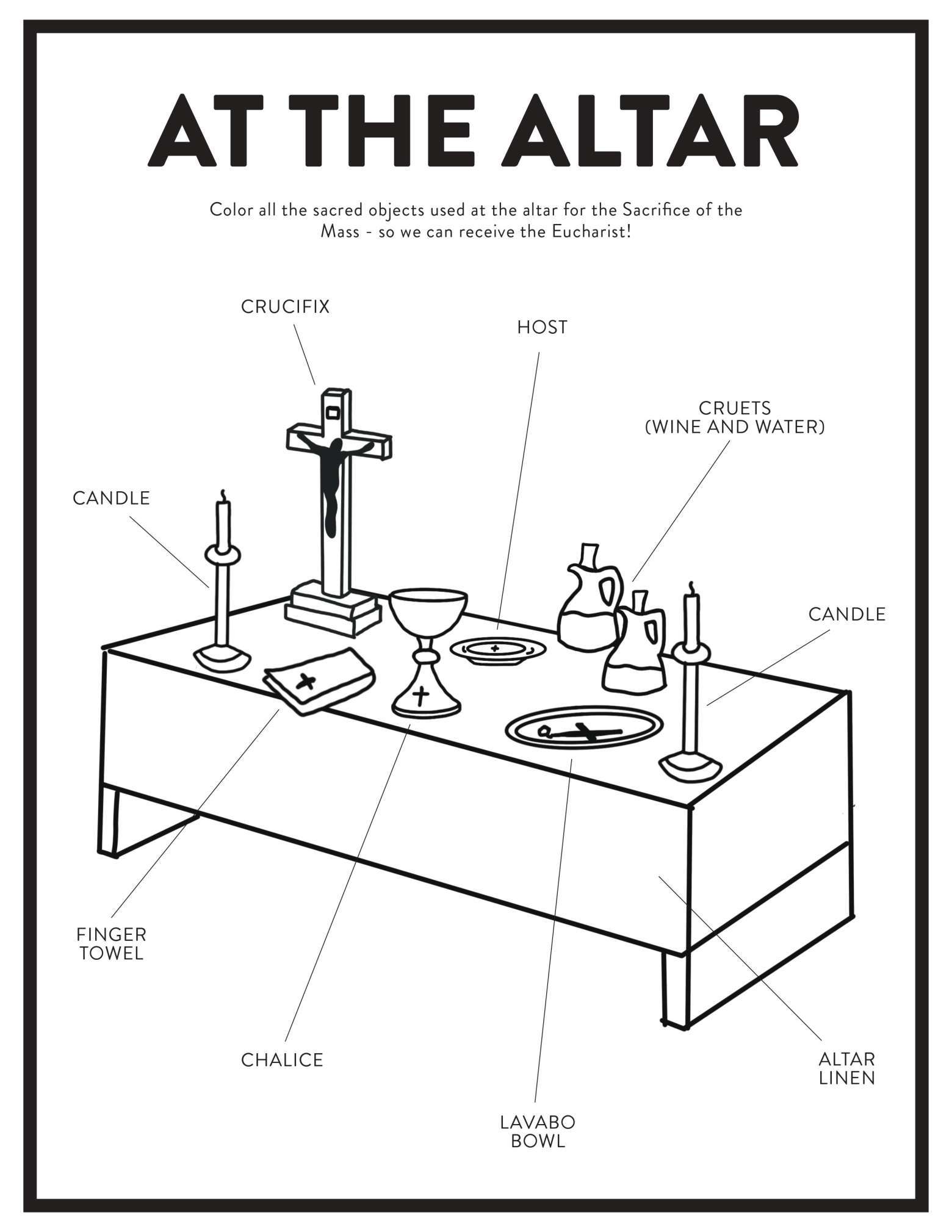
Feast of Corpus Christi Coloring Sheet
"This is my Body... This is my Blood"
There is no better expression of the Lord's love for us than the Eucharist. Not only does Jesus sacrifice Himself for us, but He also gives us Himself in the Sacraments—most especially in Holy Communion.
On the Solemnity of the Most Holy Body and Blood of Christ (Corpus Christi), we reflect on the real presence of Jesus in the Eucharist.
The consecrated bread and wine are truly changed into the Body, Blood, Soul, and Divinity of Jesus Christ.
Download and print out this coloring sheet for your kids to help them see all the beautiful objects used at Mass to prepare for Holy Communion. Remind them that in the Eucharist, we are united with the Lord!

Discuss as a family: How can you prepare yourself to receive Holy Communion?
“The greatest love story of all time is contained in a tiny white host.”
St. John’s is fortunate to have 24-hour Perpetual Adoration. Please take advantage of this beautiful opportunity to stay close to God.
We currently have three open hours:
Thursdays from 1:00 - 2:00 pm
Fridays from 6:00 - 7:00 pm & 7:00 - 8:00 pm.
Contact Kay Shomperlen at 414-763-1250 to volunteer.
Live-streaming: Mass and Adoration
We are live-streaming daily and Sunday Masses as well as Adoration for those who are unable to attend:
Daily Masses:
Monday thru Saturday 8:00 am
Weekend Masses:
Saturday at 4:30 pm
Sunday at 8:30 and 10:30 am
If you miss the Livestream, you can watch the upload of each Mass on our YouTube channel.

St. John’s Festival Booth and Game Sponsors
St. John the Evangelist invites you to support our beloved festival by becoming an official sponsor of a festival booth or game for your business or organization! Or, this year, you can even honor a loved one with a sponsorship. St. John’s extremely popular festival draws thousands of people, providing strong traffic for your sponsorship. The cost of sponsorship is $175 which includes a professionally-produced custom sign and inclusion in the daily announcements on the PA system throughout the three-day festival. To become a sponsor or if you are interested in learning more about this opportunity to not only promote your business but help St. John’s thrive for years to come, contact Dave Radke at 414-529-2356
Raffle Booth Items
We need items for the Raffle Booth, Mystery Packages, and Grocery Booth. You may drop off your items at the parish office during regular business hours.
Council Meeting
Join us on Tuesday, June 13, for our council meeting in the GYM.
We will start with praying the Rosary at 6:30 pm. The meeting will begin at 7:00 pm.
If you want to discover what the Knights are all about, join us for the Rosary or the meeting; contact Patrick or Peter.
Patrick Reiff, Membership Director, at 414-403-7504
Peter Kurz, Worthy Grand Knight, at 414-659-2656

Our K4 and K5 classes had their end-of-the-year concert celebration on June 2.
Over 100 people attended to watch the students perform on their last day of school.
The students, teachers, and parents were all smiles as the students completed the school year in song. The students also did a separate performance on Awards Day for our student body. Both performances were outstanding!
K4 & K5 Classes

Ben Oberdorf, Principal
“Keeping Our Eyes Fixed on Jesus”
— Heb:12:2

Scrip is available at all weekend Masses or during regular business hours at the parish office.

Download the RaiseRight app to reload cards, purchase ecards, or purchase physical cards. Contact the Parish Office or School Office for the enrollment code.